
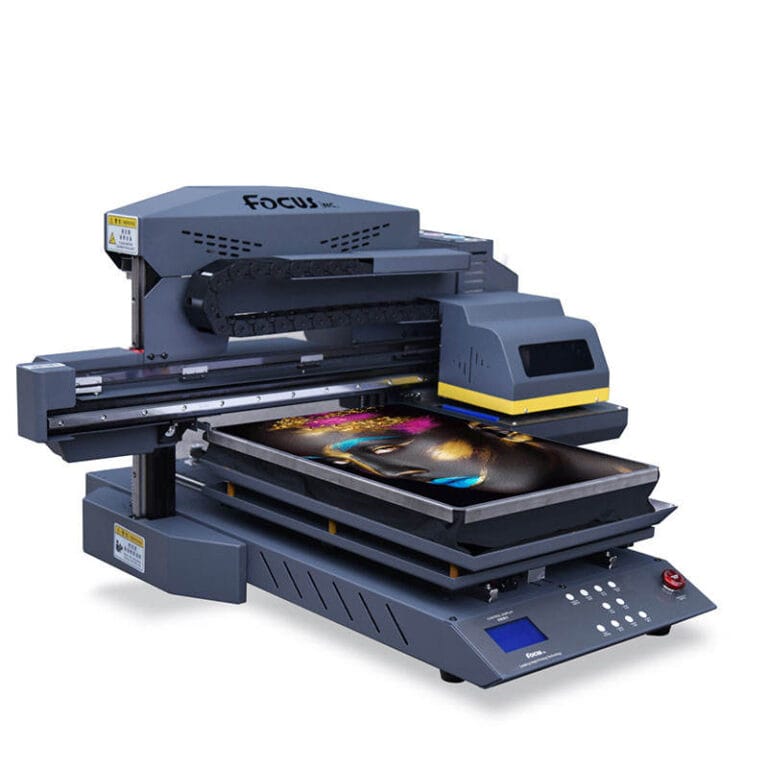
A3 DTG Printer – Direct-to-Garment T-Shirt Printing Machine
This is the other way to print a t-shirt.
DTF gives you transfers you press on. DTG skips that
entirely – the garment goes onto the platen and the
printer lays textile ink directly into the fibres.
Nothing to peel, nothing to press, nothing sitting on
the surface of the fabric.
The difference customers notice is the hand feel. A
DTG print doesn’t feel like a print. Run your palm
over it and you feel cotton, not a patch. For premium
brands, vintage-style garments, and anything sold at
a higher price point, that’s the whole argument.
The second difference is detail. Photographs,
gradients, fine shading, colour blends – DTG handles
artwork that transfer methods struggle with. If a
customer sends a portrait or a full-colour
illustration, this is the machine that does it justice.
Where it wins commercially is one-off work. No setup,
no screens, no minimum. A single custom shirt costs
you ink and thirty seconds of machine time, which
makes personalised orders profitable instead of
annoying.
CMYK plus white, so dark garments print opaque. Auto
nozzle cleaning keeps the heads healthy between jobs.
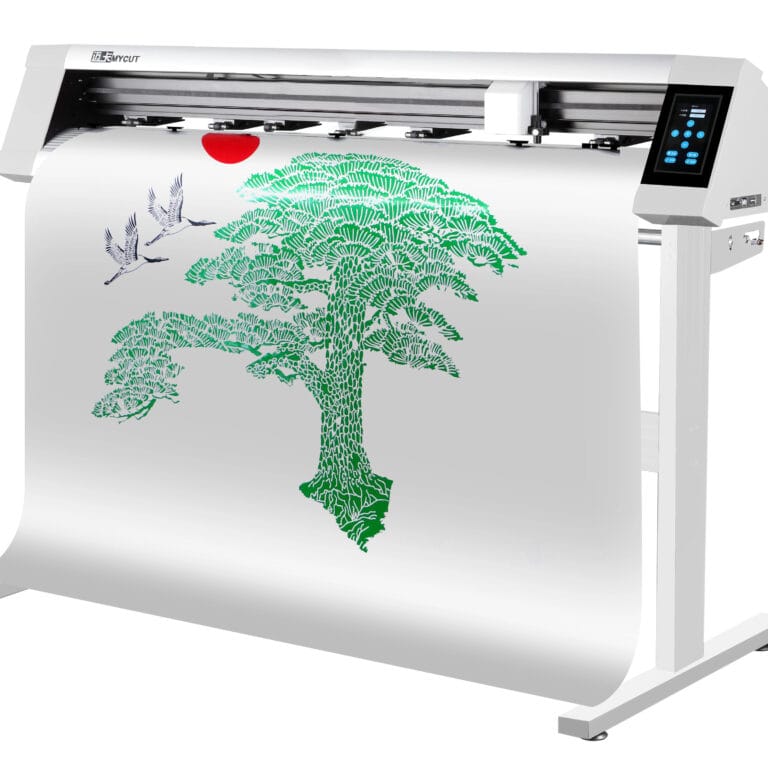
Cutting Plotter – CCD Camera Contour Cut, Touch Screen
The difference between this and a basic plotter is one
word: camera.
On a manual machine you print your stickers, then line
the sheet up by eye and hope the blade follows the
edge. Get it wrong and the whole sheet is scrap. Every
job carries that risk, and every operator learns to
work slowly because of it.
The MC1500T scans registration marks with a CCD camera
before it cuts. It locates the print, compensates for
any skew in how the sheet was loaded, and follows the
contour. Load it, press cut, walk away. That’s what
turns print-and-cut work from careful into routine.
Everything else follows from that. Full touch screen
instead of button menus, so operators learn it in an
afternoon. 256 MB cache means large jobs load once and
run without the PC staying tied up. USB, Ethernet, and
U-disk – you can walk a file over on a pen drive with
no computer connected at all.
Cuts adhesive vinyl, heat transfer vinyl, sticker
paper, reflective film, and PVC. Cutting force runs to
1000 g, so thicker materials that stall lighter
machines go through cleanly. Sheet metal and aluminium
alloy body, imported alloy steel blade.
If you’re printing stickers, labels, car decals, or
HTV and cutting them by hand alignment, this is the
machine that removes the guesswork.
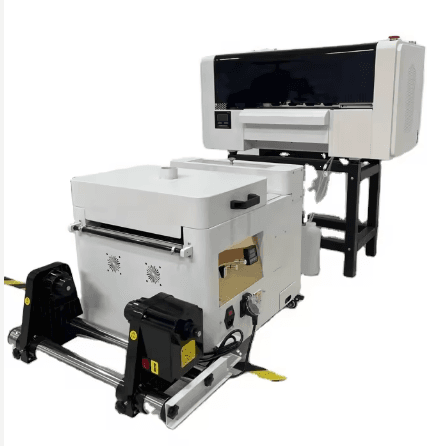
DTF Printer Machine (30 CM) – Professional DTF Printing Solution
The starting machine, and the one that fits in a room
you already have.
Most DTF setups are two separate units – a printer,
then a shaker sitting beside it, with an operator
carrying film between them. This is both in one body,
under a metre wide. Load the film, send the job, and
it prints, powders, and cures in one continuous pass.
Nothing to hand off, nothing to misalign.
At 30 cm it’s sized for a business that’s building up
rather than already running at volume. Single-piece
orders, small brand runs, reseller work — the jobs
where a 60 cm machine would sit idle most of the day.
The feature worth paying attention to is automatic
white ink stirring. White ink pigment settles when a
machine sits, and settled pigment is the single most
common cause of clogged heads. This one keeps it
circulating on its own, which matters more than any
spec sheet number if the printer isn’t running every
day.
Hiwin guide rails, so the carriage stays quiet and
accurate over time. BYHX, Hoson or Senyang board
depending on configuration. Runs on CMYK plus white,
1440 dpi, roughly 20 sqm/hour at 4-pass.
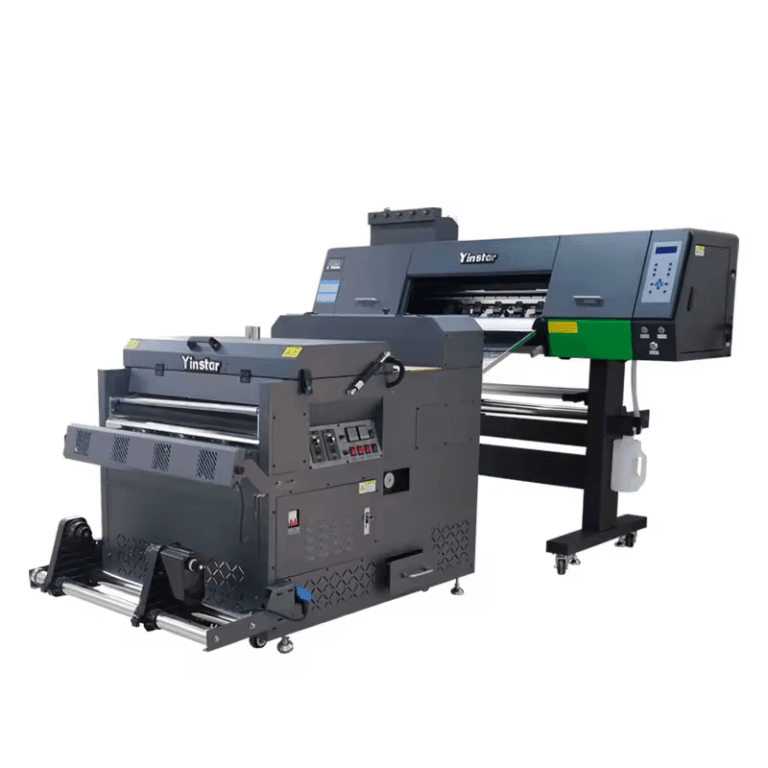
DTF Printer Machine (60 CM) – Professional DTF Printing Solution
This is the machine you buy when your 30 cm printer
has become the bottleneck.
At 60 cm (24 inches), you fit roughly twice as many
designs across the roll, so a gang sheet that took two
runs now takes one. For a lab printing daily orders,
that difference compounds fast.
The set is a complete production line, not a single
unit. The printer lays down CMYK plus white on PET
film, and the matched shaker applies hot-melt powder
and cures it in one continuous pass. Film goes in
blank at one end and comes out pressed-ready at the
other, no manual powdering, no separate oven.
Dual Epson printheads handle the white underbase and
colour layers together, which is what keeps prints
opaque on black fabric. White ink circulation runs
automatically to stop pigment settling – the single
most common cause of clogged heads on DTF machines.
Built for continuous work rather than occasional runs.
Full-automatic operation, roll-to-roll feed, and a
control panel your operator can learn in an afternoon.
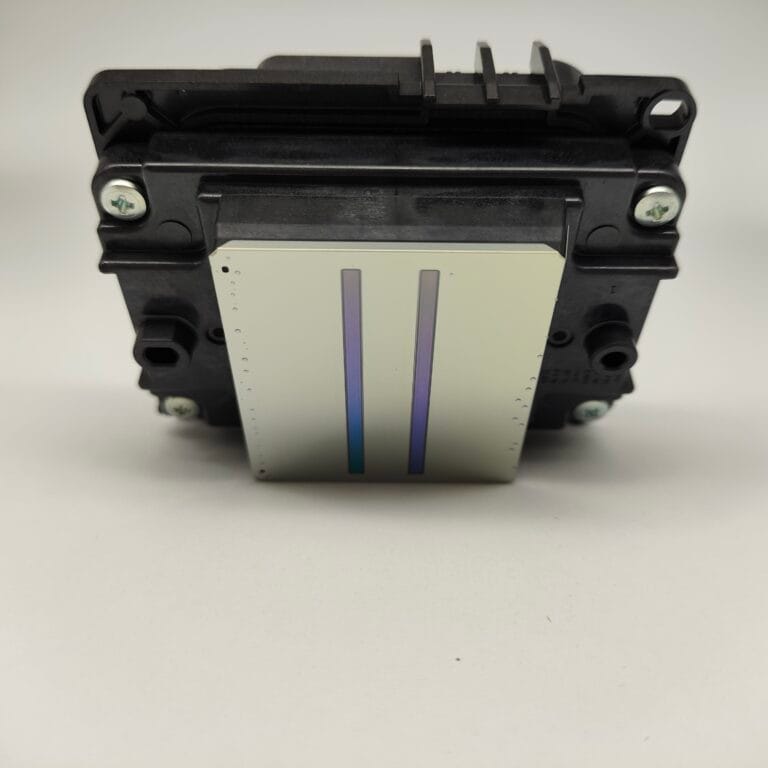
Original Epson i1600 Print Head – Genuine, Factory-Sealed
When a head goes, production stops. That’s the whole
reason to care where you buy one.
This is a genuine Epson i1600, made in Japan, arriving
factory-sealed with the Epson hologram intact. Not a
refurbished head cleaned up and resold, not a
compatible copy. If a head is being sold well below
market, there’s usually a reason, and you find out
three weeks in.
The i1600 sits in the sweet spot for DTF. It resolves
finer detail than an XP600 – thin text and small logos
come out clean instead of breaking up — and it lasts
noticeably longer under white ink, which is the ink
that kills heads fastest. Against an i3200 it costs
substantially less while handling the same everyday
work.
Fits 30 cm DTF printers, DTG machines, eco-solvent
and UV printers built around the i1600 platform.
Every head we ship is nozzle-checked before delivery.
You see the test print before you pay the balance.
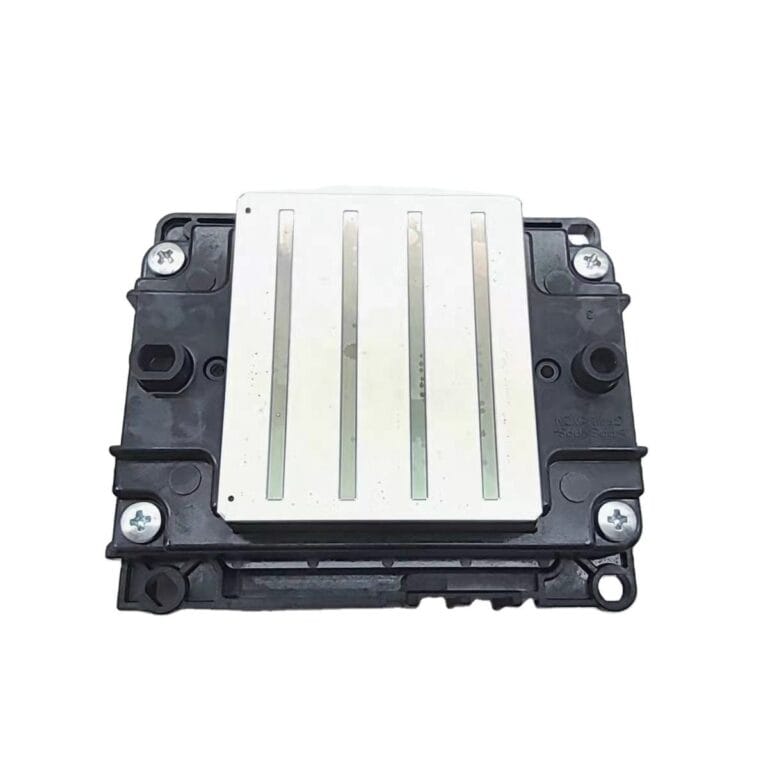
Original Epson i3200 Print Head – A1 / E1 / U1, Genuine
The production head.
If you’re running a 60 cm DTF machine, a wide-format
eco-solvent printer, or a UV flatbed doing daily
volume, this is almost certainly the head in it. The
i3200 exists for shops where the printer runs most of
the working day and downtime costs real money.
It’s faster than an i1600 or XP600 – more nozzles,
higher throughput per pass – which is why machines
built for continuous output are designed around it.
Four colour channels, and under white ink it holds up
noticeably better than the cheaper heads, which
matters because white ink is what kills printheads
first.
It costs more, and it should. A head that keeps a
production machine running is a different purchase
from a head on a desktop unit used a few times a week.
Judge it against a day of stopped production, not
against the sticker price of an XP600.
Genuine Epson, made in Japan, factory-sealed. Every
head is nozzle-checked before it ships – you see the
test print before paying the balance.
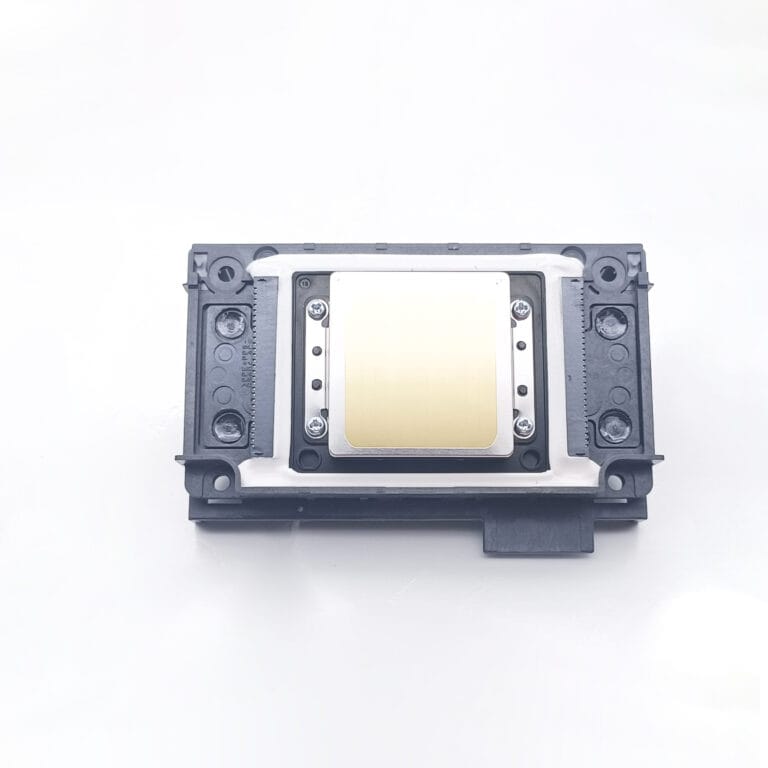
Original Epson XP600 Print Head – Genuine
The workhorse head.
More machines run on the XP600 than any other
printhead, and there’s a reason: it does the job at a
price that doesn’t hurt when it eventually wears out.
Every head is a consumable. The XP600 is the one where
that’s a manageable cost rather than a crisis.
It handles all four ink types – water-based for DTF,
eco-solvent for vinyl and banner work, UV for flatbed
and UV DTF, and solvent. One head, most of the
machines in a typical print shop. If you run more than
one type of printer, keeping an XP600 on the shelf
covers several of them at once.
It’s also the head most 30 cm DTF and eco-solvent
machines ship with from the factory, so it’s usually a
straight swap with no board changes or conversion kit.
Where it sits against the others: an i1600 resolves
finer detail and lasts longer under white ink, and an
i3200 is faster still. The XP600 costs a fraction of
either. For everyday production work, sign shops, and
anyone who wants a spare on hand, it’s the sensible
buy.
Genuine Epson, made in Japan, factory-sealed. Every
head nozzle-checked before it ships.
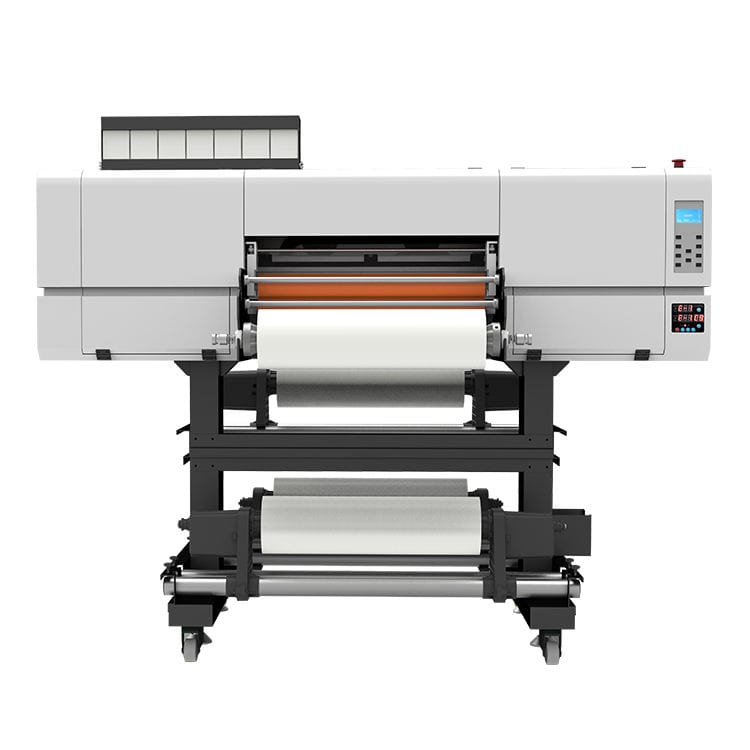
UV DTF Printer Machine – For Hard Surfaces
Different machine, different market.
This isn’t for fabric. UV DTF prints transfer that
stick to hard surfaces – tumblers, drink bottles,
phone cases, glassware, metal signage, wood, acrylic,
helmets, laptop shells. Anywhere a customer wants
their logo but a heat press can’t reach.
The workflow is simpler than fabric DTF. There’s no
powder, no shaker, no curing oven, and no heat press
at the other end. The printer lays ink onto A film,
the built-in laminator bonds B film over it in the
same pass, and the finished transfer comes off the
roll ready to use. Peel the backing, press it on by
hand, remove the top layer. Done in seconds, no
equipment needed by whoever applies it.
That last part is why this machine sells. You can
supply transfers to shops, cafés, corporate clients,
and gift sellers who have no printing equipment at
all – they just stick them on.
Prints in CMYK plus white plus varnish. The white
gives opacity on dark and transparent surfaces, and
the varnish layer adds a raised, embossed feel that
customers notice immediately. It’s the difference
between a sticker and a product.
Epson I3200 head, full-automatic roll-to-roll
operation, running on Maintop or Photoprint.

